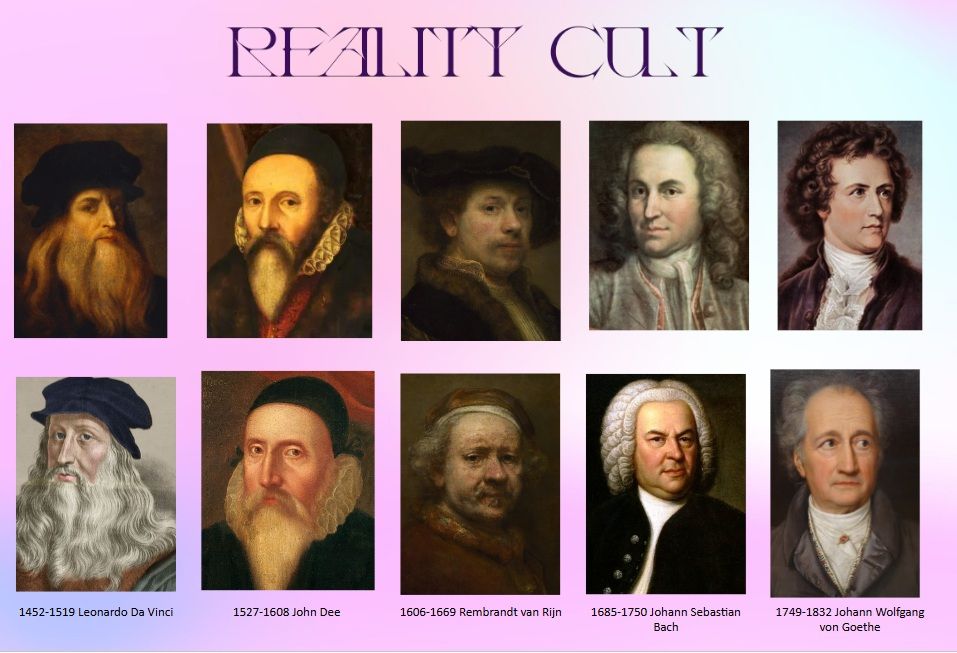
LEONARDO DA VINCI → JOHN DEE
The transition from Leonardo da Vinci into John Dee marks a further karmic movement away from embodied artistic observation toward direct engagement with hidden systems of cosmic intelligence — shifting from studying the architecture of reality through nature, anatomy, and form into consciously decoding the spiritual, mathematical, and esoteric mechanisms believed to govern existence itself.
John Dee’s chart feels like the continuation of a karmic trajectory already set into motion through Leonardo da Vinci’s life. Where da Vinci encoded knowledge into image, geometry, invention, and symbolism, Dee attempted to decode the invisible structures behind reality itself. The same soul themes return, but intensified — less grounded in physical artistry and more consumed by metaphysical inquiry, language, occult systems, and direct communion with hidden forces.
One of the clearest continuities appears through Dee’s North Node in Sagittarius in the 1st house, echoing da Vinci’s own unfinished karmic movement toward sovereignty and self-definition. In da Vinci’s life, the struggle around autonomy manifested through dependence on patrons, perfectionism, secrecy, and difficulty fully embodying his own authority. In Dee’s chart, this lesson returns again, but now through Sagittarius: the soul is asked not only to individuate, but to become a philosophical and spiritual authority in its own right. Yet the chart shows how difficult this remained. Dee repeatedly defined himself through collaborators, monarchs, and powerful mirrored relationships, especially through his entanglement with Edward Kelley.
The Gemini emphasis in Dee’s 7th house strongly suggests inherited karmic themes around communication, duality, encoded knowledge, and mirrored identity. With Uranus, the South Node, and the Part of Fortune in Gemini in the 7th house, Dee appears to carry forward the unresolved Gemini wound already visible in da Vinci’s Chiron in Gemini. In da Vinci, this manifested through hidden notebooks, mirror writing, unfinished transmissions, and a deep tension around being understood. In Dee, the same soul no longer hides the message in sketches and symbols, but attempts to speak it directly through angelic communication, occult language systems, sacred geometry, and esoteric philosophy.
This creates a striking karmic progression:
da Vinci concealed revelation through beauty and symbolism;
Dee attempted direct transmission.
Mercury further deepens this continuity. Dee’s Mercury in Cancer in the 8th house conjunct Jupiter reflects a mind immersed in hidden worlds, alchemy, spiritual systems, death, transformation, and mystical philosophy. The trines to Neptune and Chiron intensify psychic sensitivity and visionary perception, while the opposition to Pluto reveals obsession, secrecy, psychological intensity, and the dangerous burden of hidden knowledge. This feels like an evolution of da Vinci’s Mercury tensions: the soul that once encoded truth now attempts to channel it openly, even at the risk of social exile and fragmentation.
The Neptune–Chiron conjunction in Pisces in Dee’s 3rd house reinforces the theme of spiritual overwhelm through communication itself. There is a profound sensitivity around language, revelation, and the transmission of invisible realities. Dee appears almost unable to separate mystical experience from intellectual inquiry. Uranus squaring this conjunction destabilizes the system further, producing visionary breakthroughs alongside confusion, psychic overload, and fractured perception. This mirrors the prophetic and symbolic dimensions already present in da Vinci’s chart, but now amplified into explicit occult practice.
Dee’s T-square involving Pluto and Ceres in Capricorn in the 2nd house, Moon in Aquarius in the 2nd, Sun conjunct Lilith in Cancer in the 8th, and Saturn in Taurus in the 5th house reveals the immense karmic pressure surrounding value, creative expression, hidden knowledge, and power. Pluto in Capricorn suggests inherited authority and ancestral responsibility, while Lilith in the 8th radiates taboo wisdom, forbidden insight, and the archetype of the exiled mystic. Saturn in the 5th house creates fear and restriction around visibility, creativity, pleasure, and self-expression, as though the soul remembers that revelation can become dangerous. Where da Vinci could veil radical knowledge through aesthetic harmony and artistic beauty, Dee carries the heavier burden of attempting to expose the hidden structures more directly.
The Scorpio 11th house release point becomes especially important in this context. In da Vinci’s life, hidden collective knowledge remained buried within coded imagery, symbolic systems, and visionary inventions ahead of their time. In Dee’s chart, Scorpio in the 11th becomes the pathway through which hidden truths seek collective transformation. The soul appears driven to unlock what was previously concealed — to transmit esoteric systems, occult structures, and future-oriented spiritual knowledge into the collective field, even if the surrounding culture cannot yet receive it safely.
Dee’s East Point in Capricorn in the 1st house also strongly echoes da Vinci’s North Node in Capricorn. The archetype of the wise architect, disciplined magus, and builder of invisible structures becomes externalized. Dee no longer merely studies systems — he embodies them publicly, standing at the threshold between mysticism, science, mathematics, politics, and spiritual philosophy. There is a strong feeling of the soul attempting to fulfill externally what remained internally unfinished in the previous incarnation.
Together, the charts suggest a soul moving progressively deeper into the hidden architecture beneath visible reality. Da Vinci approached the divine through form, beauty, anatomy, proportion, and encoded symbolism. Dee attempted to move beyond the veil entirely — toward direct contact with the intelligence behind creation itself. Where da Vinci planted the codes, Dee tried to activate them. Where one concealed the mysteries within art and invention, the other risked fragmentation in an attempt to speak the mysteries aloud.
JOHN DEE → REMBRANDT VAN RIJN
The transition from John Dee into Rembrandt van Rijn marks a profound karmic movement away from direct occult inquiry and metaphysical abstraction toward emotional embodiment, psychological depth, and the humanization of spiritual knowledge. Where John Dee attempted to penetrate the invisible architecture behind reality through angelic communication, sacred mathematics, astrology, alchemy, and occult systems, Rembrandt appears as the soul descending back into the emotional and earthly dimensions of existence itself. The search for truth remains just as intense, but the orientation changes completely. The soul no longer seeks transcendence primarily through cosmic systems and metaphysical revelation. Instead, it begins uncovering the divine through grief, mortality, intimacy, vulnerability, shadow, human suffering, and the psychological depth of lived experience.
One of the strongest karmic continuities between the incarnations appears through Mercury. In Dee’s chart, Mercury in Cancer in the 8th house conjunct Jupiter revealed a mind immersed in hidden realities, transformation, taboo knowledge, spiritual systems, and mystical philosophy. In Rembrandt’s chart, Mercury returns again in Cancer in the 8th house, creating an almost uncanny karmic echo. The soul clearly continues carrying deep psychological sensitivity surrounding memory, death, emotional truth, hidden dimensions, and the invisible layers beneath ordinary reality. But where Dee externalized this through occult systems and metaphysical transmission, Rembrandt internalizes it emotionally and artistically. The same soul that once attempted to converse with angels now attempts to paint the interior reality of human existence itself.
The Mercury opposition to Saturn becomes especially revealing when viewed through the Dee lens. In Dee’s life, knowledge itself became dangerous and destabilizing. Revelation brought paranoia, exile, social instability, and psychological fragmentation. In Rembrandt’s chart, Mercury opposing Saturn in Capricorn in the 2nd house suggests that the burden of knowledge has now become deeply tied to survival, material reality, emotional containment, and self-worth. The soul still carries caution around expression, but now this manifests less through metaphysical secrecy and more through emotional realism, introspection, gravity, and profound psychological honesty.
The immense Scorpio emphasis in Rembrandt’s chart transforms the karmic trajectory even further. The Moon, Mars, Ascendant, and Chiron all connected to Scorpio create extraordinary emotional depth, psychological perception, shadow sensitivity, and confrontation with mortality. Dee’s incarnation already carried strong 8th house and Plutonic themes through occultism, taboo knowledge, and metaphysical obsession, but Rembrandt shifts these energies fully into embodiment. The soul no longer studies death symbolically or cosmologically. Instead, it inhabits the emotional reality of impermanence, grief, intimacy, suffering, and transformation directly.
The Moon conjunct Mars in Scorpio in the 1st house gives enormous emotional intensity and raw psychological penetration. Rembrandt appears incapable of superficial perception. The soul instinctively sees beneath appearances into pain, fragility, longing, shadow, and existential truth. This explains the extraordinary psychological realism visible throughout his portraits and self-portraits. Unlike Dee, whose consciousness often drifted upward into abstraction and transcendence, Rembrandt descends fully into embodiment — but into its deepest and most difficult dimensions.
The Scorpio Ascendant intensifies this further. The soul appears magnetically drawn toward hidden realities, emotional exposure, transformation, decay, intimacy, and existential confrontation. There is a recurring feeling throughout the chart that the soul has stopped searching for abstract cosmic order and instead seeks truth within the human condition itself.
This marks a major karmic shift in the lineage. The ecclesiastical incarnations sought divine order through doctrine and institutional hierarchy. Leonardo da Vinci sought divine intelligence through nature, geometry, and creation. John Dee sought hidden cosmic architecture through metaphysical revelation. Rembrandt seeks the divine through emotional and human truth itself.
The Sun in Cancer in the 8th house conjunct Lilith becomes one of the clearest karmic signatures in the chart. Dee’s incarnation already carried themes of forbidden knowledge, exile, dangerous revelation, and occult isolation. In Rembrandt’s life, this evolves into emotional and artistic confrontation with taboo human realities: suffering, aging, poverty, grief, emotional nakedness, sexuality, mortality, and vulnerability. Lilith conjunct the Sun suggests a soul increasingly unwilling to idealize reality or conform to social expectations surrounding beauty, morality, or emotional presentation.
Rembrandt’s art repeatedly exposed the humanity beneath social masks. This reflects the continuation of the same soul impulse visible in Dee — the refusal to remain inside accepted systems of perception — but now grounded emotionally and psychologically rather than cosmologically.
The Neptune emphasis becomes deeply important here as well. Neptune in Virgo conjunct the Midheaven suggests a public role tied to spiritualized perception, symbolic vision, emotional sensitivity, sacrifice, and artistic dissolution. But unlike Dee’s increasingly unstable mystical immersion, Rembrandt’s Neptune becomes grounded through Virgoan craftsmanship, technical mastery, discipline, and observation. The visionary impulse remains just as strong, but it now manifests through texture, realism, shadow, light, anatomy, and emotional detail rather than occult systems alone.
This feels like an important karmic correction to Dee’s life. Where Dee became increasingly consumed by transcendence and metaphysical overreach, Rembrandt’s North Node in Virgo in the 10th house attempts to ground the soul back into earthly service, disciplined work, practical mastery, and tangible contribution. The soul is learning to embody revelation through labor, technique, craftsmanship, and emotional honesty rather than through ecstatic spiritual transmission alone.
The North Node sextiling the Moon, Mars, and Sun suggests that emotional intensity itself becomes integrated into purpose. The soul’s grief, wounds, sensitivity, and psychological depth are no longer obstacles to the work — they become the work.
The T-square involving Neptune, Venus, and Jupiter becomes especially revealing in this context. Venus in Gemini in the 7th house squaring Neptune and Jupiter creates tension between intimacy and transcendence, earthly attachment and spiritual longing, relationships and projection. The soul appears deeply split between human closeness and visionary immersion. Relationships become complicated mirrors through which longing, illusion, emotional disillusionment, and projection repeatedly surface.
This reflects a continuation of Dee’s karmic instability surrounding mirrored relationships and intellectual entanglement, but in Rembrandt’s incarnation the struggle becomes deeply emotional and human rather than metaphysical or philosophical. The release point in Sagittarius in the 1st house suggests that the soul ultimately seeks authenticity, philosophical truth, and direct selfhood beyond illusion and dependency.
The Pluto themes deepen this enormously and reveal one of the clearest karmic continuities between John Dee and Rembrandt. Pluto in Taurus squaring the Sun in Cancer in the 8th house and opposing Chiron and Juno suggests profound confrontation around attachment, survival, loss, grief, emotional devastation, and the collapse of stability. In Rembrandt’s incarnation, these themes become deeply embodied through financial decline, bereavement, emotional exposure, and the stripping away of external identity. But when viewed through the lens of John Dee’s life, the symbolism becomes even more revealing.
Dee’s incarnation already carried devastating experiences of loss and collapse surrounding both worldly and spiritual structures. His library — one of the greatest collections of knowledge in Europe — was partially destroyed and looted during his absence, symbolizing not merely material loss but the destruction of the intellectual and spiritual architecture through which he understood reality. His social status deteriorated, his reputation became increasingly unstable, and many of the systems of patronage and legitimacy he relied upon began collapsing around him. There was also repeated grief surrounding illness, instability, displacement, and the death of his wife during periods of plague and social upheaval.
Seen karmically, Rembrandt’s Pluto configuration appears to continue the emotional aftermath of these collapses. The soul returns already carrying familiarity with the impermanence of status, knowledge, possessions, social recognition, and worldly security. This may partially explain why Rembrandt’s work feels so emotionally intimate with grief, fragility, mortality, and human vulnerability. The soul no longer treats loss as abstract philosophy or spiritual testing — it understands loss intimately.
Pluto in Taurus suggests that the soul is repeatedly forced to confront the instability of everything it once tried to preserve or build. In Dee’s life, this manifested through the collapse of intellectual structures, public standing, and spiritual certainty. In Rembrandt’s incarnation, the same karmic current becomes deeply personal and emotional through bankruptcy, bereavement, relational suffering, and social decline.
The opposition to Chiron intensifies this further, suggesting wounds connected to betrayal, exile, emotional exposure, and existential vulnerability. Dee’s life already carried profound isolation through his role as an occult philosopher existing between worlds — simultaneously revered and distrusted, intellectually brilliant yet increasingly marginalized. Rembrandt inherits this existential loneliness, but grounds it emotionally and psychologically rather than metaphysically.
The opposition to Juno also becomes significant karmically. Dee’s life was deeply shaped through spiritually and intellectually charged partnerships, particularly the complicated dynamic with Edward Kelley, where mirrored ambition, revelation, dependency, and instability became entangled. The chart suggests unresolved karmic residue surrounding trust, intimacy, collaboration, and relational projection carrying forward into Rembrandt’s life. In Rembrandt’s incarnation, these tensions become more emotionally embodied through relationships marked by grief, attachment, loss, and emotional complexity.
This gives Rembrandt’s later work extraordinary depth. The soul is no longer idealizing transcendence or seeking escape through cosmic revelation. It has already witnessed the collapse of systems, identities, knowledge structures, and worldly legitimacy in previous incarnations. What remains is the raw emotional truth beneath illusion itself.
That is why Rembrandt’s gaze feels so different from Dee’s. Dee still searched upward toward hidden celestial intelligence, attempting to decode the invisible architecture behind reality. Rembrandt turns fully toward the human condition and asks what remains after collapse, grief, humiliation, aging, death, and disillusionment strip away every external structure.
The answer, increasingly, becomes presence itself.
REMBRANDT VAN RIJN → JOHANN SEBASTIAN BACH
The transition from Rembrandt into Bach marks a karmic movement from emotional shadow and human suffering into sacred structure, devotional discipline, and spiritual architecture through sound. Where Rembrandt searched for the divine inside grief, mortality, poverty, aging, and the human face, Bach appears as the same soul trying to organize that emotional depth into divine order — transforming shadow into harmony, loss into devotion, and inner intensity into a musical cathedral.
Bach’s chart carries a striking continuation of the emotional and Plutonic themes visible in Rembrandt’s life, but the expression becomes far more structured, devotional, and service-oriented. Rembrandt’s chart was filled with 8th house, Scorpio, Pluto, grief, survival, and emotional exposure; Bach’s chart continues this through Pluto in Cancer in the 4th house, forming a powerful T-square with Jupiter in Libra in the 7th house and the Sun conjunct the Aries Ascendant in the 1st house. This shows a soul still carrying deep ancestral, familial, and emotional pressure, but now forced to balance private pain, relational obligation, and personal will through work, faith, and public legacy.
Pluto in Cancer in the 4th house feels especially important after Rembrandt. In Rembrandt’s life, the soul experienced devastating losses around family, partners, children, home, money, and status. In Bach’s chart, Pluto in Cancer suggests that the emotional root system itself has become charged with karmic intensity. Family is not simple; home is not light; ancestry carries pressure. The soul comes in with deep memory of emotional survival, grief, and the collapse of security. This can also be seen biographically in Bach’s life through early orphanhood, the death of his first wife while he was away, and the repeated deaths of children. The old Rembrandt wound around loss and impermanence does not disappear. It becomes absorbed into family, duty, faith, and sacred labor.
The Sun in Aries conjunct the Ascendant shows a much stronger impulse toward individual force than in Rembrandt’s chart. After the heavy emotional inwardness of Rembrandt, Bach comes in with a more direct life force, a sharper identity, and a stronger will to create. Yet the square from Pluto shows that this selfhood is still pressured by deep emotional inheritance. The Aries self wants to assert, lead, and create from its own fire, but Pluto in Cancer pulls it back into family karma, grief, ancestral duty, and emotional responsibility. This reflects a soul trying to become a vessel of divine order while still carrying the emotional sediment of previous incarnations.
Jupiter in Libra in the 7th house adds another layer of relational karma. After Dee’s entanglement with Kelley and Rembrandt’s painful relational losses, Bach’s chart again places enormous significance on partnership. Jupiter in Libra expands devotion to harmony, marriage, collaboration, and sacred relational balance, but because it is part of the T-square, partnership is not simply supportive. It becomes one of the places where the soul’s unresolved tension plays out. Bach’s relationship with Anna Magdalena fits this very clearly: not only a wife, but a musical collaborator, copyist, emotional companion, and part of the living household structure through which his work continued. The soul is still learning how to hold partnership without disappearing into duty or projection.
The release point of this T-square in Capricorn in the 10th house becomes crucial. The emotional intensity of Pluto in Cancer, the relational expansion of Jupiter in Libra, and the self-assertion of Sun-Ascendant in Aries all seek resolution through Capricornian legacy, structure, discipline, and public contribution. This is where Bach’s soul seems to take the raw emotional material inherited from Rembrandt and turn it into something enduring. Rembrandt painted grief through light and flesh; Bach organizes grief into divine structure, counterpoint, rhythm, sacred proportion, and musical architecture. The soul no longer only witnesses suffering. It builds a cathedral from it.
At the same time, Bach’s own North Node in Cancer shows that this was not only about public achievement. The soul was also being asked to develop emotional rootedness, family connection, tenderness, and devotional feeling. This is a fascinating continuation after Rembrandt. Rembrandt’s life broke open the soul through personal grief and human vulnerability. Bach then returns with a soul path that asks him to live inside family, home, lineage, care, and emotional belonging, even while the Capricorn release point demands public structure and mastery. This creates the paradox of Bach’s life: he was a towering architect of sacred music, but his work was inseparable from family life, church service, domestic responsibility, and emotional devotion.
The 8th house Mars conjunct Juno in Sagittarius deepens the karmic continuation of intimate fusion and spiritually charged partnership. After Dee’s mystical partnership with Kelley and Rembrandt’s deeply emotional relational losses, Bach’s Mars-Juno conjunction suggests a marriage or soul bond infused with creative fire, spiritual purpose, shared resources, and transformative intensity. In Sagittarius, this bond is not merely domestic; it carries faith, meaning, devotion, and expansion. But because Mars-Juno squares Saturn in Virgo in the 6th house and Venus in Pisces in the 12th house, the relationship also becomes tied to sacrifice, labor, duty, spiritual idealization, and exhaustion.
Saturn in Virgo in the 6th house is one of the clearest signatures of Bach’s life. It shows relentless discipline, service, daily work, technical precision, and the burden of function. After Rembrandt’s financial collapse and social decline, Bach’s chart seems to create a karmic counterweight: the soul now survives through order, routine, craft, and service. Yet Saturn in the 6th can also become overwork, physical strain, humility bordering on self-erasure, and a sense that one’s worth must be proven through constant labor. Bach’s enormous output and demanding roles as composer, cantor, teacher, organist, and father all reflect this placement intensely.
Venus in Pisces in the 12th house, together with Neptune, Mercury, and Vesta in Pisces, reveals the mystical core of Bach’s chart. This is the soul of devotional music, sacred surrender, hidden longing, and artistic transmission from beyond the personal ego. The 12th house Pisces stellium suggests that Bach’s creativity did not come only from personal ambition. It came through him as service, prayer, offering, and spiritual channel. After Dee’s attempts to communicate with angels and Rembrandt’s descent into human suffering, Bach becomes a vessel through which the invisible is organized into sound.
This Pisces 12th house emphasis also shows the danger of dissolution. The soul can lose itself in service, sacrifice, divine longing, and the needs of others. Venus in Pisces square Mars-Juno suggests a tension between personal love and spiritual devotion, between earthly partnership and the idealized sacred bond, between desire and surrender. Juno square Neptune adds the possibility of romantic or spiritual projection within partnership, suggesting that even sacred union could blur boundaries or demand sacrifice. This echoes Dee’s wife-sharing episode and spiritualized relational confusion in a much more devotional, domestic, and musical form. The soul is still learning where divine service ends and personal selfhood begins.
Mercury and Vesta in Pisces in the 12th house show sacred concentration through invisible pattern, sound, and inner listening. Mercury here does not communicate like Dee’s Mercury in occult language or Rembrandt’s Mercury through psychological depth. In Bach, Mercury becomes musical, symbolic, devotional, and almost liturgical. The mind speaks through divine proportion and emotional resonance. Vesta adds sacred dedication, making composition feel like ritual service. This is the soul still working as a priest of invisible architecture, but now the temple is music.
The Moon in Aquarius in the 12th house, conjunct the Part of Fortune, adds emotional detachment and collective orientation. Bach’s emotional fulfillment appears tied to service beyond the personal self: music for God, for church, for humanity, for a larger order. This carries a continuation from Dee’s cosmic abstraction and Rembrandt’s human universality. But in Bach, the feeling becomes less personal and more transpersonal. The soul can survive enormous grief by placing emotion into a larger spiritual structure. This may be part of why Bach could endure so many losses and still continue producing work of extraordinary order and beauty.
The Grand Earth Trine involving Chiron and Uranus in Taurus in the 1st house, Saturn in Virgo in the 6th house, and the Capricorn Midheaven is one of the strongest stabilizing patterns in the chart. After Rembrandt’s deep Plutonic losses, this earth trine gives the soul the capacity to manifest, endure, structure, and build. Chiron in Taurus in the 1st house suggests a wound around embodiment, safety, self-worth, and physical existence itself. Uranus conjunct Chiron adds genius, difference, and a disruptive originality in the way the soul inhabits form. This can describe a being whose identity carries both wound and innovation, someone who heals through radically embodied craft.
Saturn in Virgo gives the discipline to refine that wound into skill, while the Capricorn Midheaven gives the public mission of legacy. This configuration shows why Bach could take immense internal sensitivity and turn it into forms that still endure centuries later. It is a chart of sacred craftsmanship: pain made useful, grief made precise, devotion made architectural.
Lilith in Taurus in the 1st house trining Saturn adds another important layer. Lilith in Taurus suggests shadow around sensuality, embodiment, value, pleasure, and material power. After Rembrandt’s financial collapse and confrontations with survival, Bach carries a quieter but still potent wound around earthly security and personal worth. Yet the trine to Saturn means this shadow can be disciplined, contained, and transformed into mastery. The body, the voice, the hands, the instrument, the material world itself become vehicles of sacred work.
The Aries 12th house placements, including Pallas and the East Point, squaring the Capricorn Midheaven and Cancer North Node, suggest a hidden warrior-intelligence beneath Bach’s devotional surface. There is unconscious fire, strategy, and identity force operating behind the humility of service. This may explain why Bach, though outwardly devoted to church structures and duty, was also uncompromising, intense, and at times difficult within institutions. The soul still carries the rebellious and sovereign thread from earlier incarnations: the da Vinci need for autonomous genius, the Dee need to construct a personal cosmology, and the Rembrandt refusal to beautify reality falsely. In Bach, this becomes hidden fire under sacred discipline.
Seen through the lens of Rembrandt as the most recent past life, Bach’s chart reads like a soul trying to repair fragmentation through sacred order. Rembrandt had descended deeply into the human condition, confronting grief, mortality, poverty, loss, and psychological shadow. Bach does not reject that depth, but he refuses to leave it raw. He turns it into fugue, chorale, passion, counterpoint, structure, and praise. The soul takes Rembrandt’s chiaroscuro and makes it audible.
There is also a deeper continuity from the lives before Rembrandt. Dee’s obsession with cosmic architecture becomes Bach’s musical architecture. Da Vinci’s sacred geometry becomes harmonic proportion. The earlier ecclesiastical lives return as church music, liturgy, and divine service, but now with the soul no longer simply representing religious authority. Bach becomes the servant of divine order through creation itself.
This is why Bach’s chart feels like a temporary stabilization in the lineage. After the metaphysical intensity of Dee and the emotional devastation of Rembrandt, Bach channels the accumulated soul material into disciplined sacred form. Yet the chart also shows that this stabilization came at a cost. The heavy 6th, 8th, and 12th house signatures suggest overwork, sacrifice, emotional fusion, hidden grief, and spiritual self-erasure. The soul builds something eternal, but often by dissolving the personal self into duty, family, God, and work.
Ultimately, Bach’s chart reveals a soul attempting to transform inherited grief into sacred function. The emotional losses carried from Rembrandt, the occult architecture carried from Dee, the visionary structure carried from da Vinci, and the religious lineage before that all converge into one life of devotional mastery. Bach does not merely compose music. He organizes centuries of karmic intensity into living structure.
Where Rembrandt found God in the human face, Bach finds God in order, sound, devotion, and form. His chart suggests that the soul is learning how to make suffering useful without denying its depth, how to serve the divine without disappearing completely, and how to build a legacy that can hold both grief and transcendence inside one sacred architecture.
JOHANN SEBASTIAN BACH → JOHANN WOLFGANG VAN GOETHE
The transition from Johann Sebastian Bach into Johann Wolfgang von Goethe marks a profound karmic evolution from devotional surrender into conscious selfhood — from sacred service into embodied spiritual sovereignty. Where Bach dissolved himself into divine structure, music, family, and religious devotion, Goethe appears as the same soul beginning to consciously reclaim individuality, intellectual authority, and creative autonomy. The emotional, mystical, and sacrificial intensity visible throughout Bach’s incarnation does not disappear in Goethe’s chart, but it becomes reorganized into philosophy, science, literature, psychological inquiry, and the construction of a self-defined worldview.
One of the clearest karmic continuities appears through the nodal axis. Bach’s chart already carried immense Capricornian pressure through the release point of his major T-square and through his Capricorn Midheaven, suggesting that the soul was being pushed toward structure, public legacy, mastery, and self-defined contribution. Yet Bach’s own North Node remained in Cancer, keeping the soul deeply entangled with family, devotion, emotional caretaking, and sacrificial service. His life became inseparable from emotional obligation, domestic responsibility, and spiritual labor. He poured himself into family systems, church structures, and sacred function, often at the expense of personal autonomy.
Goethe’s chart immediately reveals the next karmic step. His North Node now sits directly in Capricorn in the 2nd house, suggesting that the soul has returned specifically to develop inner authority, material self-worth, autonomy, and sovereign self-construction. What remained unfinished in Bach becomes the explicit evolutionary task in Goethe. The soul no longer wishes merely to serve divine structure — it now seeks to embody structure consciously through its own philosophy, intellect, creative vision, and personal legacy.
This creates a striking karmic progression. Bach’s life revolved around devotion to God, family, music, and sacred order. Goethe’s incarnation gradually pivots toward self-authorship, intellectual mastery, and philosophical individuation. Where Bach dissolved into music and service, Goethe begins building a coherent selfhood.
The emotional and mystical inheritance from Bach remains deeply visible in Goethe’s chart, however, especially through the enormous emphasis on water and Scorpio energy. Goethe’s Pluto at 29 degrees Scorpio in the 1st house becomes one of the most important karmic signatures in the lineage. Bach’s Pluto in Cancer in the 4th house already carried profound ancestral weight, emotional intensity, family karma, and transformational grief tied to roots, lineage, home, and emotional survival. Goethe externalizes this Plutonic current directly into identity itself. The hidden emotional underworld Bach carried internally now becomes embodied outwardly through Goethe’s personality, magnetism, psychology, philosophy, and creative presence.
This shift feels enormously significant karmically. Bach internalized emotional intensity through sacred duty and devotional labor. Goethe consciously inhabits transformation itself. Pluto in the 1st house gives a soul that cannot remain superficial. Identity becomes a process of continual death and rebirth. The soul begins confronting shadow, power, desire, mortality, instinct, psychology, and spiritual transformation directly rather than sublimating these themes entirely into sacred function.
The grand water trine involving Pluto in Scorpio, Neptune in Cancer in the 8th house, and Jupiter in Pisces in the 4th house becomes one of the clearest continuations of Bach’s mystical and emotional inheritance. Bach’s chart already carried overwhelming 12th house Pisces energy through Venus, Mercury, Neptune, and Vesta in Pisces, combined with the Moon and Part of Fortune in Aquarius in the 12th house. His life was steeped in devotional mysticism, emotional surrender, spiritual service, and creative transcendence.
Goethe inherits this same spiritual sensitivity, but the water trine allows the soul to channel it more consciously into philosophy, literature, psychology, symbolism, and personal transformation. The mystical current no longer flows only through sacred music and religious structure. It now flows through poetics, self-reflection, scientific inquiry, emotional philosophy, archetypal exploration, and the direct study of life itself.
This marks a profound evolution in spiritual orientation. Bach approached the divine through reverence, surrender, precision, and devotional service. Goethe seeks the divine through embodiment, experience, nature, paradox, psychological depth, and direct participation in existence itself.
The Virgo emphasis in Goethe’s chart reveals another important karmic correction. Bach’s chart already contained strong Virgo themes through Saturn in Virgo in the 6th house and through the immense discipline and structural precision required for his musical architecture. But Bach’s Virgo function remained tied to service, labor, duty, and self-sacrifice. Goethe’s chart takes Virgo and externalizes it through conscious intellectual refinement. His Sun and Lilith in Virgo in the 9th house, together with Venus conjunct Juno in Virgo in the 10th house, reveal a soul attempting to purify thought, refine philosophy, construct meaning carefully, and create public work rooted in precision, discernment, and intellectual integrity.
Where Bach built sacred musical structures for God, Goethe builds philosophical and symbolic structures for humanity.
The Sun conjunct Lilith in Virgo in the 9th house feels especially important here. Lilith introduces a rebellious, untamed, and independent current into Goethe’s intellectual and philosophical identity. The soul no longer wishes merely to preserve sacred systems — it wants to question them, refine them, deconstruct them, and move beyond inherited doctrine. This reflects a major departure from Bach’s life, which remained deeply embedded within religious institutions and devotional frameworks.
Yet the continuity remains visible underneath. Bach’s music already carried hidden mystical architecture, mathematical beauty, emotional transcendence, and sacred symbolism. Goethe inherits this same sacred craftsmanship but redirects it outward into literature, science, aesthetics, and philosophical inquiry. Bach internalized divine proportion into sound. Goethe articulates it consciously through language and thought.
The Mercury-Uranus T-square in Goethe’s chart becomes one of the clearest signatures of this intellectual evolution. Mercury in Leo in the 9th house opposing Uranus in Aquarius in the 3rd house and squaring the Scorpio Ascendant creates immense tension between creative self-expression, intellectual rebellion, visionary thought, and personal identity.
Bach’s incarnation was emotionally and spiritually immersive, but also structurally contained. Goethe’s Mercury-Uranus dynamic breaks open those containers. The soul now experiments intellectually, philosophically, artistically, and psychologically. There is a need to innovate, challenge consensus reality, and develop an entirely personal cosmology. This mirrors earlier incarnations in the lineage as well — particularly John Dee’s metaphysical experimentation and Leonardo da Vinci’s intellectual boundary-crossing. But in Goethe, these impulses become psychologically integrated rather than occultly fragmented.
The Scorpio Ascendant intensifies this enormously. Goethe’s identity itself becomes transformative terrain. The soul appears increasingly willing to descend consciously into shadow, contradiction, instinct, desire, and existential depth. This differs greatly from Bach’s more humble and self-effacing orientation. Goethe no longer hides entirely behind service. He becomes visible as thinker, philosopher, cultural architect, and psychological explorer.
At the same time, the Taurus Descendant release point reveals the soul’s ongoing need for grounding, embodiment, sensuality, relational stability, and earthly connection. Bach’s release point already fell in Gemini in the 2nd house, pointing toward communication, self-worth, and independent value systems. Goethe evolves this further through Taurus themes: stable relationships, grounded creativity, beauty, sensuality, and tangible manifestation. The soul is learning not only to think and create, but to inhabit life more fully.
The Grand Earth Trine in Goethe’s chart further confirms this stabilization process. Ceres in Taurus in the 5th house, Sun and Lilith in Virgo in the 9th, and Mars plus the North Node in Capricorn in the 2nd house create a powerful flow between creativity, intellectual mastery, practical embodiment, and long-term legacy-building.
This feels like the soul finally learning how to ground its immense spiritual, emotional, and symbolic intelligence into durable worldly structures without disappearing entirely into sacrifice.
Bach’s Grand Earth Trine already showed enormous capacity for disciplined sacred craftsmanship through Saturn in Virgo, Uranus and Chiron in Taurus, and the Capricorn Midheaven. Goethe inherits and evolves this earthy architecture, but now the emphasis becomes less about serving inherited systems and more about constructing an individual worldview and cultural legacy.
The Chiron themes deepen this even further. Goethe’s Chiron in Libra in the 11th house suggests wounds around belonging, intellectual community, social harmony, and relational integration. Bach’s chart already carried tension between identity and partnership through Jupiter in Libra opposing his 1st house Aries cluster. The soul repeatedly struggles with balancing individuality and collective belonging, self-expression and relational harmony.
But Goethe’s incarnation approaches this more consciously. Uranus trining Chiron suggests that healing comes through originality, intellectual freedom, and breaking inherited relational patterns. The soul is no longer merely enduring emotional sacrifice. It is attempting to understand itself psychologically and spiritually through conscious individuation.
Seen across the broader lineage, Goethe feels like an extraordinary integration point.
The earlier ecclesiastical incarnations sought divine authority through institutional religion.
Leonardo sought sacred intelligence through nature and geometry.
John Dee pursued cosmic revelation through occult systems.
Rembrandt descended into emotional truth and human suffering.
Bach transformed grief and transcendence into sacred musical architecture.
Goethe inherits all of these currents simultaneously — mysticism, structure, philosophy, art, science, emotional depth, symbolism, rebellion, and devotion — but attempts to synthesize them into one consciously embodied worldview.
This is why Goethe’s incarnation feels less fragmented than several earlier lives. The soul is no longer oscillating as violently between transcendence and embodiment. It begins attempting integration.
The mystical and emotional inheritance remains fully alive, but now the soul wants to understand itself as creator rather than merely servant or vessel.
Where Bach built cathedrals of sound for the divine, Goethe begins constructing an inner philosophy through which the soul itself becomes the temple.
JOHANN WOLFGANG VAN GOETHE → GUSTAVE DORÉ
The transition from Goethe into Gustave Doré marks a karmic movement from philosophical embodiment and self-constructed worldview into vast visual mythmaking — as if the soul that had tried to understand nature, spirit, poetry, science, and the self through Goethe now begins translating the entire symbolic imagination into image.
Gustave Doré’s chart reveals a soul carrying the structural mastery of Bach, the philosophical breadth of Goethe, the visionary coding of da Vinci, the occult architecture of Dee, and the emotional shadow-depth of Rembrandt — but now compressed into an intensely productive, image-generating incarnation. The chart feels like a soul attempting to externalize entire inner worlds through art, mythology, literature, religion, and archetypal vision. Where Goethe sought to become a living temple of spirit through philosophy, poetry, science, and selfhood, Doré becomes almost like an overactive visual cathedral: endlessly producing images, worlds, scenes, symbols, and dramatic spiritual landscapes.
The North Node conjunct Vesta in Leo in the 8th house is one of the strongest signatures in the chart. This points to a soul path centered around sacred creative intensity, visibility, transformation, death, inheritance, taboo, and the dramatic illumination of hidden psychic material. Leo asks for radiant self-expression, but the 8th house pulls that radiance into darkness, mortality, eroticism, shadow, fear, and transformation. Vesta conjunct the North Node makes this creative path devotional, almost priestly. Doré was not simply meant to create images; he was meant to serve a sacred flame through image-making. His immense artistic production can be read through this placement as a form of ritual devotion, where the soul channels underworld material into dramatic visual form.
This placement strongly continues Goethe’s evolution. Goethe’s chart had moved the soul toward Capricorn selfhood, Virgo refinement, Scorpio transformation, and philosophical embodiment. In Doré, that integrated worldview becomes visualized. Goethe internalized nature, myth, spirit, and philosophy into a self-created cosmology; Doré turns that cosmology outward into illustrations of Dante, the Bible, fairy tales, literature, myth, and collective imagination. The 8th house Leo North Node suggests that the soul is now asked to shine inside the depths — to bring light into fear, death, sin, divine punishment, redemption, shadow, and the unseen psychological layers of humanity.
Yet this North Node-Vesta conjunction sits inside a powerful T-square with Chiron in Taurus on the cusp of the 4th and 5th houses and Pallas, Uranus, and the Moon in Aquarius in the 2nd house. This creates a deep karmic conflict between creative destiny, bodily safety, self-worth, emotional detachment, and the wound of pleasure or personal expression. Chiron in Taurus suggests an old wound around embodiment, value, material security, sensuality, and the right to create from ease. In the 5th house area, this becomes a wound around joy, play, artistic pleasure, and childlike creative expression; near the 4th cusp, it also touches home, emotional roots, and belonging.
This feels important when viewed through Bach and Goethe. Bach carried Chiron in Taurus in the 1st, connected to embodiment, self-worth, and the transformation of wound into disciplined sacred form. Goethe developed Taurus through the Part of Fortune in the 7th and the need for grounded relational and aesthetic embodiment. In Doré, Taurus becomes wounded again through Chiron. The soul may have gained structure and philosophical selfhood in Goethe, but now confronts the cost of over-identifying with production, vision, and externalized creative output. The body, pleasure, and inner safety become fragile.
The Aquarius 2nd house emphasis intensifies this. Pallas and Uranus in Aquarius, joined by the Moon and later Ceres and Jupiter in Aquarius, place enormous pressure on value, money, self-worth, talent, and inner resources. Aquarius in the 2nd suggests unusual gifts, visionary intelligence, future-oriented perception, and a detached relationship to personal security. The soul’s value does not come through ordinary stability, but through strange genius, innovation, and the ability to see collective patterns. Uranus and Pallas opposing the North Node-Vesta conjunction suggest that Doré’s sacred creative fire was constantly challenged by mental abstraction, social detachment, and the need to make visionary intelligence materially valuable.
The Moon in Aquarius in the 2nd house opposing Vesta and the North Node adds emotional distance from the very fire the soul is meant to embody. The feeling nature becomes cool, observational, mentally displaced, or tied to productivity and value. This can describe a soul that produces immense work while remaining emotionally split from its own needs. It also echoes earlier incarnations: Dee’s mental abstraction, Bach’s Moon in Aquarius in the 12th, and Goethe’s Uranus in Aquarius in the 3rd. The Aquarius current repeatedly brings genius, distance, and collective orientation — but also a risk of emotional dissociation.
The release point of the T-square falls into Scorpio around the 10th and 11th house area, exactly where the Part of Fortune sits in Scorpio in the 11th house. This is highly significant. The pressure of Leo creative destiny, Taurus embodiment wound, and Aquarius mental and value detachment seeks release through Scorpio collective depth: hidden networks, collective shadow, taboo imagery, psychological transformation, and the creation of works that speak into the underworld of the collective imagination. Doré’s Part of Fortune in Scorpio in the 11th suggests that fulfillment comes through giving form to collective fears, myths, religious visions, and unconscious material. His art becomes a vessel for the shadow of humanity, not merely personal expression.
This links directly back to Rembrandt and Dee. Rembrandt sought God through shadow, grief, mortality, and the human face. Dee attempted to unlock hidden collective codes. In Doré, these two currents merge: the hidden code becomes visual, and the human shadow becomes mythic. The soul is no longer only painting intimate psychological darkness like Rembrandt, or speaking with invisible intelligences like Dee. It is illustrating the collective underworld itself.
The grand earth trine involving Chiron in Taurus, Juno and Saturn in Virgo in the 9th house, and the Sun, East Point, and Lilith in Capricorn in the 1st house gives Doré enormous capacity for labor, discipline, manifestation, and artistic productivity. This is one of the clearest inheritances from Bach and Goethe. Bach carried sacred structure through Saturn in Virgo and a grand earth trine that allowed spiritual energy to become music. Goethe carried earth mastery through Capricorn, Virgo, and Taurus, turning devotion into selfhood, philosophy, and cultural legacy. Doré continues this earth mastery, but it becomes almost extreme: the soul can materialize inner visions at staggering speed and scale.
The Sun in Capricorn in the 1st house gives a serious, driven, self-defining, ambitious, and highly work-oriented identity. The East Point in Capricorn reinforces the archetype of someone perceived through mastery, control, productivity, and public seriousness. Lilith in Capricorn in the 1st adds a shadowed intensity to identity: a taboo relationship with authority, ambition, discipline, and selfhood. There is a sense of someone who must become a structure, almost at the expense of softness. This strongly echoes Goethe’s Capricorn North Node in the 2nd house, but in Doré the Capricorn energy has moved into the visible self. Goethe learned to build inner authority; Doré embodies authority as a working identity.
At the same time, the Sun-Lilith-East Point conjunction also suggests a soul that tightly regulates instinct, vulnerability, and emotional exposure through work, mastery, and artistic output. Lilith in Capricorn often does not externalize itself openly, but instead sublimates longing, erotic tension, emotional complexity, or taboo aspects of identity into ambition, productivity, aesthetic devotion, and control. Combined with the immense Virgo-Capricorn earth emphasis, there is a recurring feeling throughout the chart that emotional and instinctual life becomes organized through labor and symbolic creation rather than directly embodied.
This becomes especially striking through the opposition between the Aquarius 2nd house cluster and the North Node-Vesta conjunction in Leo in the 8th house. The soul appears pulled between emotional detachment and the deeper longing for passionate self-revelation, intimacy, vulnerability, and embodied creative radiance. Desire itself may become displaced into aesthetics, mythology, admiration, artistic circles, and symbolic worlds rather than openly lived. Venus at the anaretic 29th degree of Scorpio in the 11th house intensifies this further, suggesting emotionally charged but highly private relational dynamics, hidden longing, and intimacy patterns intertwined with collective, artistic, or symbolic environments.
The Cancer 7th house release point of the Pluto-Sun-Midheaven T-square reinforces the sense that emotional softness, relational safety, and direct vulnerability remain difficult but deeply necessary evolutionary themes for the soul. There is a strong feeling that artistic production became both expression and concealment — a way of transmitting immense emotional and erotic intensity indirectly through image, mythology, beauty, shadow, and collective imagination. When viewed through the broader lineage, this also resonates with recurring soul themes around sublimation, hidden longing, artistic transmutation of desire, mirrored identities, and the tension between public role and private instinct that already appeared in subtler forms in earlier incarnations.
Saturn and Juno in Virgo in the 9th house bring discipline, devotion, and karmic contracts into religion, publishing, philosophy, meaning, travel, education, and large symbolic systems. Doré’s work with biblical, literary, mythological, and epic themes is strongly reflected here. Virgo brings craft, detail, precision, and service; the 9th house brings grand narratives, theology, myth, philosophy, and higher meaning. Saturn in Virgo in the 9th suggests a soul carrying serious responsibility around symbolic worlds, religious imagery, and cultural interpretation. Juno there suggests a kind of marriage to meaning itself — a binding contract with literature, myth, faith, and large-scale spiritual imagination.
This is where the earlier ecclesiastical lives, da Vinci, Dee, Bach, and Goethe all converge. The soul has been moving for centuries through religion, hidden knowledge, sacred structure, divine order, music, philosophy, and symbolic systems. In Doré, that entire inheritance becomes illustration: the Bible, Dante, Milton, Cervantes, fairy tales, and collective myth rendered as visible architecture.
The fire grand trine between Pluto in Aries in the 3rd house, Vesta and the North Node in Leo in the 8th, and Mars in Sagittarius in the 12th adds enormous creative ignition. This is a deeply visionary and almost compulsive configuration. Pluto in Aries in the 3rd gives intensity to the mind, language, drawing, perception, and communication. It suggests a mind that does not merely think, but burns. In Aries, Pluto pushes toward raw force and pioneering expression; in the 3rd, it transforms communication into a vehicle of power. This connects back to Dee’s dangerous knowledge, Goethe’s Mercury-Uranus intellectual force, and da Vinci’s coded communication — but in Doré it becomes visual storytelling with volcanic speed.
Mars in Sagittarius in the 12th house adds hidden fire, spiritual restlessness, unconscious drive, and a compulsion toward vast mythic or religious horizons. It is the fire of pilgrimage, faith, battle, and visionary escape, but hidden in the 12th house where it can become unconscious overwork, spiritual exhaustion, or action driven by invisible pressure. Mars trining the North Node and Vesta suggests that this hidden fire feeds the creative mission directly. Doré’s productivity can be read as 12th house Mars constantly pouring unconscious symbolic material into the North Node-Vesta flame.
The Sagittarius Ascendant conjunct Mars amplifies the mythic, expansive, restless quality of the incarnation. Doré’s identity is not small or local; it reaches toward epic scale. The Ascendant trining Vesta and sextiling Moon, Uranus, and Pallas gives access to visionary intelligence and creative fire, but its squares to Saturn and Juno in Virgo show tension between freedom and discipline, inspiration and duty, expansion and craft. The soul wants vastness, but the work demands precision. This is the same tension seen throughout the lineage: divine immensity must be contained in form.
Pluto in Aries also forms a T-square with the Midheaven in Libra and the Sun and East Point in Capricorn, with the release point in Cancer in the 7th house. This is a major karmic pattern around power, identity, public image, and relationship. The Sun in Capricorn wants self-mastery, control, work, and achievement. The Libra Midheaven seeks public harmony, aesthetics, beauty, and social recognition. Pluto in Aries in the 3rd pushes raw, forceful, transformative expression that can disrupt both. The Cancer 7th house release point suggests that the soul’s way out would involve emotional softness, intimacy, relational vulnerability, and allowing dependency or tenderness rather than only producing, mastering, and projecting.
This feels especially important through Goethe as the prior life. Goethe had worked to develop sovereign selfhood and intellectual authority after Bach’s devotional fusion. Doré inherits that selfhood, but perhaps overcorrects into Capricornian work identity and relentless output. The release into Cancer partnership suggests a missing softness: the soul may need emotional attachment, home, and relational safety, yet struggles to prioritize it.
The Mercury-Neptune conjunction in Capricorn in the 2nd house sextiling Venus in Scorpio in the 11th is another crucial signature. Mercury conjunct Neptune gives a visionary, imaginal, symbolic, and highly porous mind. In Capricorn and the 2nd house, the dream is made practical, valuable, and productive. The soul can turn imagination into material worth. This reflects Doré’s ability to make fantasy concrete and commercially visible. But Mercury-Neptune can also blur reality and support escapism through work, fantasy, or aesthetic immersion. In the 2nd house, the imagination becomes tied to livelihood and self-worth, making production feel necessary not only creatively but materially and psychologically.
Venus at 29 degrees Scorpio in the 11th house sextiling Mercury-Neptune adds intense aesthetic power, emotional magnetism, and attraction to dark collective themes. The anaretic degree intensifies Venus: beauty becomes extreme, haunted, emotionally charged, and karmically loaded. In Scorpio and the 11th, love and beauty are not merely personal; they are tied to collective shadow, hidden networks, artistic circles, and the emotional undercurrents of society. Venus squaring Ceres and Jupiter in Aquarius in the 2nd suggests tension between dark aesthetic intensity and the need for material security, public productivity, and collective value. The soul may be pulled between intimate emotional truth and the demands of social or commercial output.
Ceres, Jupiter, and the Moon in Aquarius in the 2nd house create a large field around nurturing, expansion, emotional security, and value through unusual ideas and collective imagination. Jupiter in Aquarius in the 2nd can bring abundance through visionary talent, originality, and mass appeal, while also exaggerating detachment from ordinary needs. Ceres in Aquarius suggests nurturing others through images, ideas, culture, and collective vision rather than direct emotional intimacy. The square to Venus in Scorpio shows the tension between emotional intensity and intellectualized or collective forms of care. Doré’s art may have become the place where intimacy was displaced: he nourished the collective imagination, perhaps while remaining personally more hidden or emotionally contained.
The Midheaven in Libra trining Moon, Uranus, Pallas, and Jupiter in Aquarius and sextiling Vesta and Mars shows why Doré could become publicly known through aesthetic harmony, visual intelligence, and cultural reach. Libra at the Midheaven gives beauty, style, composition, and public artistic recognition. The Aquarius trines bring originality and collective resonance, while the sextiles to fire placements give inspiration and creative force. But the Midheaven’s involvement in the Pluto-Sun T-square also shows public success as pressure. Visibility is not simple. It activates identity tension, power, ambition, and the wound around relational softness.
Juno and Saturn in Virgo in the 9th house squaring Mars and the Ascendant show that Doré’s relationship to meaning, work, publishing, and cultural systems was deeply demanding. This is the chart of someone bound to produce, refine, serve, and translate vast symbolic worlds with precision. Juno here may show marriage not primarily to a person, but to the work, the canon, the great texts, the religious and literary imagination. Saturn makes that bond heavy. Mars and the Ascendant in Sagittarius want wild expansion, but Saturn-Juno in Virgo demands discipline, detail, and endless craftsmanship.
Seen through the full lineage, Doré feels like the soul entering a phase of massive externalization. The earlier ecclesiastical and religious authority lives create the theological and symbolic inheritance. Da Vinci turns sacred authority into visual and anatomical intelligence. Dee turns it into occult code. Rembrandt turns it into human shadow and emotional truth. Bach turns it into sacred musical structure. Goethe turns it into philosophy, nature, selfhood, and conscious spiritual embodiment. Doré then gathers all of this and pours it into image — not slowly, not gently, but almost compulsively.
The chart suggests that the soul has become a machine of symbolic production, but the deeper wound lies in whether the creator is actually embodied inside the creation. The North Node-Vesta in Leo in the 8th asks for sacred creative radiance through the underworld, but the Aquarius 2nd house and Capricorn 1st house can detach and overwork. Chiron in Taurus asks the soul to heal embodiment, pleasure, self-worth, and the right to create without exhausting itself. The release through Scorpio in the 11th asks the soul to share shadow with the collective, but not disappear into the collective imagination entirely.
Ultimately, Gustave Doré’s chart reveals a soul translating centuries of spiritual, artistic, intellectual, and emotional memory into vast visual myth. The incarnation carries Goethe’s philosophical scope, Bach’s sacred structure, Rembrandt’s shadow, Dee’s hidden architecture, and da Vinci’s visionary image-making. Yet the karmic challenge is intense: to avoid turning imagination into another form of escape, labor into another form of dissociation, and artistic brilliance into a substitute for embodied intimacy.
Where Goethe became a living temple of spirit, Doré becomes an overflowing cathedral of images. The soul is still seeking God, myth, truth, and transformation — but now through the dramatic visual theater of the collective unconscious.
GUSTAVE DORÉ → CHARLES JEROME POLLITT
The transition from Gustave Doré into Charles Jerome Pollitt marks a dramatic karmic movement away from repression, sacred labor, visionary overproduction, and monumental artistic isolation toward theatricality, glamour, aesthetic experimentation, nightlife, and identity fluidity. After the immense psychic compression visible throughout Doré’s incarnation — where the soul became almost consumed by symbolic output, mythic imagination, discipline, and artistic devotion — Pollitt appears as a soul attempting to rupture centuries of restraint through performance, atmosphere, beauty, social immersion, erotic ambiguity, and collective aesthetic experience.
Charles Jerome Pollitt’s recorded birth data does not include a confirmed birth time, which means the house system, Ascendant, and Midheaven cannot be used reliably in this analysis. Because of this, the reading focuses primarily on planetary placements, nodal dynamics, and aspects rather than house-based interpretation. While this creates a less spatially precise analysis, the symbolic and karmic patterns remain highly revealing when viewed through the broader continuity of the lineage.
Pollitt’s chart reveals a transitional phase in the soul’s evolution: a consciousness moving away from the heavy Saturnian and Capricornian burden carried through Doré, Goethe, Bach, and even earlier incarnations, yet not fully capable of grounding freedom, embodiment, intimacy, or selfhood in a stable way. The chart repeatedly suggests a soul loosening itself after centuries of discipline, sacred obligation, symbolic responsibility, emotional containment, and transcendence through work.
If Doré represented the soul trapped inside labor, mythic imagination, artistic devotion, and emotional sublimation, Pollitt represents the first dramatic outward eruption into decadence, theatricality, social experimentation, queer visibility, glamour, nightlife, and aesthetic liberation. Yet the chart suggests this liberation remained unstable — less an integrated awakening than a pendulum swing away from repression into atmosphere, performance, intoxication, and dissolution.
One of the clearest karmic signatures in Pollitt’s chart is the nodal axis itself: the North Node at 29° Gemini, the South Node at 29° Sagittarius, and Saturn in early Capricorn closely aligned with the South Node side of the axis. Although Saturn is technically in Capricorn rather than Sagittarius, it still operates within the same karmic field because of its proximity to the South Node and its opposition to the North Node in Gemini.
This creates a powerful symbolic structure: the soul attempting to move toward Gemini multiplicity, experimentation, fluidity, theatricality, relational exchange, and identity play while simultaneously being pulled backward by Saturnian heaviness, repression, perfectionism, labor, control, and inherited psychological rigidity.
The South Node in Sagittarius resonates profoundly with the previous incarnations in the lineage. Doré’s life was deeply Sagittarian in archetypal tone: monumental biblical imagery, visionary symbolism, transcendent mythology, literary immersion, spiritual longing, and obsessive identification with worlds larger than ordinary human life. Goethe carried this same current through philosophy, metaphysics, universalism, and the construction of an all-encompassing worldview. Bach expressed it devotionally through sacred musical architecture. Dee pursued transcendence through occult systems and cosmic revelation. The lineage repeatedly moved upward toward symbolic totality, sacred structure, transcendence, and mythic consciousness.
But Pollitt’s chart suggests the soul becoming exhausted by transcendence-through-structure.
Saturn in early Capricorn intensifies this dramatically. Saturn introduces heaviness, labor, discipline, repression, perfectionism, emotional containment, and exhaustion. Through Doré’s incarnation this manifested as compulsive artistic productivity and relentless symbolic labor — not simply ambition, but sublimation and psychic escape. The work itself became transcendence. Rather than fully inhabiting intimacy, embodiment, vulnerability, or instinct, the soul increasingly disappeared into production, mythology, symbolic worlds, and visionary imagination.
There is also a strong intuitive sense that the earliest seeds of escapism through intoxication may already have begun in Doré’s incarnation, even if not explicitly documented historically. The chart strongly suggests increasing tendencies toward emotional dissociation, immersion in fantasy, overstimulation through artistic environments, subtle forms of self-erasure through work, and perhaps growing attraction toward decadent atmospheres, alcohol, or altered emotional states as release mechanisms from psychic compression. The soul appears increasingly unable to remain fully grounded inside ordinary reality without symbolic or atmospheric transcendence.
Pollitt’s North Node in Gemini represents the soul attempting to loosen itself after centuries of psychic density, sacred labor, emotional sublimation, and symbolic isolation. The evolutionary movement now shifts toward multiplicity, experimentation, conversation, performance, social movement, theatricality, and identity fluidity.
Where Doré sublimated desire into work, Pollitt externalized it into atmosphere.
Where Doré escaped through visionary overproduction, Pollitt escaped through glamour, nightlife, parties, social intoxication, performance, and aesthetic immersion.
Where Doré controlled himself rigidly, Pollitt experimented with theatricality, beauty, queer identity play, erotic ambiguity, and collective aesthetic experience.
Yet because Saturn remains tightly connected to the South Node side of the axis, the liberation remains psychologically unstable. Rather than integrating freedom consciously, the soul drifts increasingly toward glamour, atmosphere, artistic circles, nightlife, social performance, intoxication, and orbiting charismatic figures.
This becomes especially visible through the Cancer-Leo emphasis in the chart.
The Sun conjunct Uranus in Cancer creates a deeply unconventional emotional identity. Uranus disrupts inherited structures, norms, and identity expectations, while Cancer makes these disruptions emotional, psychological, fluid, nostalgic, and intimate. Pollitt’s existence itself challenged Edwardian social expectations surrounding gender, sexuality, performance, and aesthetic self-presentation.
But Cancer also longs for softness, emotional safety, intimacy, and belonging. Pollitt’s rebellion therefore does not emerge primarily through aggression or domination, but through glamour, theatricality, aesthetic magnetism, emotional ambiguity, beauty, and social atmosphere. The rebellion becomes atmospheric rather than confrontational.
The Sun-Uranus conjunction strongly suggests someone whose social existence itself became performative disruption.
This becomes especially meaningful when viewed through the earlier lineage. Doré’s chart already revealed immense tension between disciplined public identity and hidden instinctual life through the Capricorn Sun-Lilith conjunction, the Cancer release point of the Pluto T-square, and the displacement of emotional and erotic intensity into artistic production. Pollitt appears to inherit this unresolved material directly, but rather than sublimating it entirely into work, the soul begins expressing it socially, theatrically, and aesthetically.
The chart strongly suggests the emergence of a more visible queer current within the lineage. Doré’s incarnation carried signs of emotional repression, sublimated longing, hidden erotic complexity, and identity containment through labor and symbolic creation. In Pollitt, these energies become externalized through performance, nightlife culture, aesthetic identity, social experimentation, gender play, and theatrical self-presentation.
Yet the chart still suggests indirect embodiment rather than fully grounded selfhood.
Neptune square the Sun complicates everything enormously. Neptune introduces glamour, intoxication, fantasy, porous identity boundaries, projection, escapism, aesthetic longing, collective dream-fields, and emotional dissolution. The soul desires liberation and transcendence, but struggles with stable embodiment and coherent identity.
This aspect strongly echoes the previous incarnations. Dee disappeared increasingly into occult systems and metaphysical revelation. Bach dissolved into sacred service and devotional labor. Goethe sublimated enormous emotional and mystical intensity into philosophy and self-construction. Doré vanished into image-production, mythology, and visionary immersion. Pollitt shifts the same dissolving tendency outward into glamour, nightlife, beauty, atmosphere, performance, and collective intoxication.
The external forms change, but the karmic movement remains strikingly consistent: difficulty remaining fully incarnated within ordinary reality without immersion into fantasy, artistic obsession, collective emotion, altered states, myth, or symbolic transcendence.
Pollitt’s movement toward Hollywood becomes highly symbolic within this trajectory. Hollywood represents collective dream machinery itself: glamour, projection, archetypal identity, celebrity mythology, fantasy construction, and manufactured illusion. Pollitt appears deeply drawn toward this world, partly as escape from the instability and heaviness surrounding the war era, yet simultaneously unable or unwilling to fully claim creative centrality within it himself.
Instead, the chart suggests someone more comfortable orbiting brilliance than fully occupying it directly.
The lingering Sagittarian South Node pattern still seeks myth, atmosphere, symbolism, collective enchantment, and aesthetic transcendence, while the Gemini North Node asks for direct participation, experimentation, interaction, multiplicity, and embodied social exchange. Pollitt partially moves toward this evolutionary direction, but often indirectly. Rather than becoming the central artist, he frequently appears as patron, muse, amplifier, connoisseur, connector, or aesthetic catalyst surrounding other creators.
The Venus-Jupiter sextile reinforces this strongly. Venus in Virgo refines artistic discernment, aesthetic sensitivity, and curatorial intelligence, while Jupiter in Cancer expands emotional generosity, hospitality, patronage, and collective bonding. Pollitt appears highly gifted at recognizing beauty, nurturing talent, cultivating atmosphere, and amplifying artistic culture around him.
But Venus in Virgo also carries hesitation, self-critical restraint, refinement anxiety, and insecurity. The artistic instinct becomes observational and curatorial rather than fully self-assertive. Instead of embodying the artwork directly, the soul becomes highly attuned to surrounding glamour, beauty, artistry, and cultural atmosphere.
This mirrors Doré profoundly. Doré created monumental visionary worlds yet appears emotionally distant from direct embodied intimacy itself. Pollitt shifts this same pattern outward socially, immersing himself in glamorous and artistic environments while still struggling to stabilize creative sovereignty internally.
Mars in Libra square Jupiter in Cancer adds another layer of social excess and dissipated momentum. Mars in Libra seeks seduction, performance, beauty, relational movement, aesthetic harmony, and social exchange, but often struggles with direct assertion. The square to Jupiter exaggerates pleasure-seeking, theatricality, over-socialization, indulgence, and atmospheric excess.
This aspect strongly reflects the energetic atmosphere surrounding Pollitt’s later years: nightlife, salons, artistic elites, glamour circles, bohemian environments, parties, alcohol, and drifting through collective pleasure-fields rather than consolidating identity inwardly.
There is a strong sense throughout the chart of someone dissolving into atmosphere rather than solidifying selfhood.
The Moon in Leo intensifies the theatrical and performative dimension enormously. The Moon here craves radiance, admiration, glamour, emotional visibility, dramatic expression, and social magnetism. Yet because so much of the chart is watery, Venusian, Neptunian, and relational, the Leo Moon does not fully stabilize into sovereign individuality. Instead, it seeks fulfillment through artistic circles, queer subcultures, salons, nightlife, performance spaces, collective emotional atmospheres, and aesthetic exchange.
Pollitt appears emotionally nourished by bohemian environments themselves.
The Moon trine Neptune deepens this enormously. It creates profound aesthetic receptivity, fantasy orientation, emotional permeability, and susceptibility to altered emotional states through beauty, music, romance, glamour, intoxication, performance, and collective emotional fields.
The relationship with Aleister Crowley becomes especially revealing within this framework. Crowley appears almost as a catalytic polarity figure for Pollitt: embodying will, occult authority, ritualized identity construction, active transgression, and conscious myth-making. Pollitt, by contrast, appears more receptive, glamorous, atmospheric, aesthetic, relational, and dissolving.
The connection likely intensified both liberation and fragmentation already visible within the chart. Together they amplified occult experimentation, queer identity play, nightlife culture, erotic ambiguity, glamour, spiritual rebellion, theatricality, and ecstatic excess.
One of the most revealing aspects in Pollitt’s chart is Jupiter opposite Saturn. This creates a lifelong oscillation between liberation and restraint, indulgence and discipline, transcendence and structure, expansion and repression.
Seen through the lineage, this aspect perfectly bridges the earlier incarnations.
Doré lived heavily through Saturn: discipline, labor, sublimation, perfectionism, symbolic devotion, control, isolation, and overwork. Goethe attempted to construct philosophical selfhood and intellectual mastery from within inherited mystical and emotional intensity. Bach dissolved personal identity into sacred order, devotional structure, and service.
Pollitt represents the soul beginning to rebel against centuries of compression, but not yet capable of integrating freedom consciously or sustainably.
Ultimately, Pollitt’s chart reveals a soul in destabilizing transition.
The incarnation appears less about mastery than rupture — breaking open old karmic structures inherited from lifetimes of repression, sacred labor, visionary production, emotional containment, symbolic devotion, and transcendence through work.
But because the liberation remains ungrounded, the soul drifts increasingly toward atmospheric existence: glamour, parties, performance, nightlife, aesthetic intoxication, artistic circles, queer sociality, alcohol, erotic experimentation, and collective dissolution.
The life becomes liminal — neither fully embodied creator nor hidden laborer.
Instead, Pollitt represents the soul learning theatricality, fluidity, glamour, seduction, aesthetic magnetism, rebellion, queer visibility, and social power, while still struggling to develop the grounded center necessary to sustain authentic freedom.
In this phase of the lineage, the soul is no longer building cathedrals, composing sacred order, philosophizing nature, or illustrating myth. It is beginning to become the atmosphere itself — a living aesthetic current moving through salons, stages, occult circles, friendships, performances, and collective dream-worlds, testing whether liberation can exist without dissolving the self entirely.
CHARLES JEROME POLLITT → JIM MORRISON
The transition from Charles Jerome Pollitt into Jim Morrison marks the moment where the soul no longer merely circles myth, glamour, intoxication, performance, and collective ecstasy from the edges, but fully incarnates inside them. What remained atmospheric, socially performative, aesthetically suggestive, and partially indirect in Pollitt becomes explosive, collective, eroticized, and culturally mythic through Morrison. The soul no longer orbits the spectacle — it becomes the spectacle itself.
Jim Morrison’s chart reveals a consciousness moving through cycles of artistic magnetism, rebellion, erotic intensity, spiritual longing, self-destruction, and ecstatic dissolution. Through the lens of karmic astrology, the chart strongly suggests a continuation of unresolved themes carried through Pollitt’s incarnation: theatricality, fluid identity, nightlife culture, glamour, occult fascination, aesthetic intoxication, social magnetism, and the tension between transcendence and embodiment.
At the center of Morrison’s chart stands the North Node conjunct Pluto in Leo in the 6th house, one of the most karmically charged placements in the chart. This conjunction suggests a soul undergoing radical transformation through creative embodiment, disciplined self-expression, visibility, artistry, purification, and service. Leo seeks radiance, performance, dramatic identity, and mythic selfhood, while Pluto intensifies everything it touches, bringing obsession, power, extremity, death-rebirth cycles, psychological compulsion, and karmic intensity.
Through the lens of Pollitt, this conjunction becomes deeply revealing. Pollitt appears to have lived largely through atmosphere, aesthetic influence, social magnetism, artistic circles, glamour, and energetic presence rather than through sustained creative embodiment itself. He moved through bohemian and occult worlds almost like a living muse or catalyst: amplifying others, orbiting visionaries, immersing himself in nightlife, beauty, intoxication, performance culture, and collective emotional fields.
There is a strong sense of someone deeply aware of glamour, archetype, charisma, performance, and social myth-making — yet without fully grounding his own creative force into structured purpose or sustained authorship.
This becomes especially important karmically because Morrison’s North Node conjunct Pluto in Leo points directly toward what Pollitt avoided or dissolved away from: disciplined self-expression, embodied creativity, grounded artistic force, and sustained occupation of the stage itself.
Rather than remaining near the myth, Morrison becomes consumed by it.
Pollitt’s life appears deeply tied to indirect participation. He frequently functioned more as patron, muse, amplifier, social catalyst, or aesthetic presence within artistic and occult circles rather than fully occupying the central creator role himself. The Leo desire for radiance was present, but often expressed indirectly through orbiting charismatic figures, theatrical environments, aristocratic circles, and occult personalities rather than fully claiming visibility independently.
This pattern intensified after Pollitt moved toward Hollywood, partly as escape from the instability and heaviness surrounding the war era. Hollywood becomes highly symbolic karmically: collective dream machinery itself — glamour, projection, celebrity mythology, fantasy construction, and manufactured archetypes. Pollitt appears deeply drawn toward this world while simultaneously remaining observational within it, drifting through atmospheres of fame, excess, nightlife, alcohol, social intoxication, and aesthetic immersion rather than fully incarnating creative authorship himself.
Morrison’s chart can almost be read as the soul attempting to violently correct this pattern.
The North Node-Pluto conjunction demands full embodiment of charisma, authorship, visibility, and creative force. But because Pluto is involved, the lesson becomes dangerous and extreme. The soul swings from passive orbiting of myth toward becoming myth itself.
The earlier lineage becomes highly visible underneath this movement. Dee pursued transcendence through occult revelation and dangerous knowledge. Bach sublimated identity into sacred service and devotional structure. Goethe attempted philosophical and psychological self-construction. Doré dissolved into visionary overproduction and symbolic immersion. Pollitt dissolved into atmosphere, nightlife, glamour, theatricality, and collective aesthetic experience.
Morrison inherits all of these currents simultaneously.
The occult fascination from Dee returns through Morrison’s obsession with altered consciousness, ritual, death, symbolism, and hidden realities. Bach’s ecstatic devotional longing reappears distorted through music, performance, and collective trance rather than sacred liturgy. Goethe’s self-mythologizing and philosophical existentialism return through Morrison’s poetic identity construction. Doré’s immersion in collective shadow and mythic imagery resurfaces through Morrison’s fascination with apocalypse, death, archetypes, erotic darkness, and symbolic performance. Pollitt’s fluid theatricality, glamour, nightlife culture, queer-adjacent ambiguity, aesthetic magnetism, and intoxicated social immersion erupt outward fully.
Morrison becomes the convergence point where centuries of symbolic, artistic, mystical, erotic, and self-destructive soul material fuse into one public figure.
Neptune in Libra in the 8th house forms one of the deepest karmic signatures in the chart. Neptune here reveals a soul intoxicated by transcendence, erotic fusion, altered states, glamour, psychic merging, occultism, and dissolution of boundaries. The 8th house amplifies themes of sexuality, taboo, death, transformation, power, and psychological merging.
Morrison did not merely perform rebellion — he sought mystical annihilation through sex, poetry, performance, substances, ritual, and altered consciousness.
This placement strongly echoes Pollitt’s immersion within occult and bohemian circles revolving around Crowley, theatrical identity play, aesthetic excess, nightlife culture, ritualized performance, and erotic experimentation. Pollitt’s life already carried themes of altered identity, ecstatic atmosphere, social performance, and dissolution through glamour and collective emotional fields. Morrison inherits this same energetic current, but intensifies it dramatically.
The difference is scale.
Pollitt moved through underground artistic and occult subcultures. Morrison became a collective cultural archetype.
Mercury square Neptune intensifies this further, creating a mind capable of profound symbolic perception, visionary poetry, archetypal thinking, and artistic genius, yet also vulnerable to mythologizing, confusion, escapism, fragmentation, intoxication, and unstable relationships with reality itself.
Through the Pollitt lens, this reflects a soul already accustomed to performance as identity construction — where masks, personas, glamour, theatricality, and atmosphere gradually become inseparable from authentic selfhood.
The 7th house cluster involving Chiron, Lilith, Jupiter, and Vertex in Virgo reveals deep karmic wounds surrounding intimacy, projection, erotic dependency, relational instability, and public desire. Morrison’s relationships repeatedly became battlegrounds for unresolved pain, longing, emotional chaos, seduction, power struggles, and impossible expectations.
Chiron in Virgo suggests wounds around inadequacy, purification, embodiment, and the inability to fully heal oneself or others. Lilith in Leo adds themes of dangerous visibility, erotic rebellion, scandal, seduction, rejection, and fascination with taboo self-expression.
These placements strongly resonate with Pollitt’s life within queer, bohemian, artistic, and occult subcultures existing outside mainstream social acceptance. Pollitt’s femininity, theatricality, and fluid social role likely made him simultaneously fetishized, admired, destabilizing, and marginal. Morrison inherits this same karmic tension around being both worshipped and condemned. The soul learns to weaponize charisma, beauty, eroticism, theatricality, and artistic magnetism while internally remaining emotionally fragmented and unstable.
Juno in Aquarius in the 12th house deepens this pattern enormously. Juno reflects soul contracts and relational karma, while the 12th house governs hidden realities, exile, sacrifice, fantasy, unconscious patterns, and dissolution. Morrison’s relationships often carried themes of projection, invisibility, longing, martyrdom, emotional disappearance, and unattainable union.
Love becomes intertwined with intoxication, fantasy, escape, and self-loss.
This mirrors Pollitt’s relational dynamics within occult and artistic underground circles: relationships built not merely on affection, but on projection, role-play, artistic intoxication, glamour, ritualized identity, and mutual destabilization. The 12th house placement suggests Morrison carried unresolved karmic residue around surrendering identity inside emotionally consuming relational fields.
Rather than forming grounded intimacy, he repeatedly disappeared into emotionally overwhelming dynamics.
The Moon in Taurus square Pluto and opposite Venus reveals profound emotional trauma surrounding security, abandonment, possession, love, sensuality, attachment, and emotional survival. Morrison longed deeply for beauty, grounding, loyalty, sensuality, and emotional peace, yet repeatedly gravitated toward chaos, obsession, betrayal, emotional extremity, and destabilization.
Seen through Pollitt’s incarnation, these aspects suggest the continuation of karmic vulnerability linked to lives built around atmosphere, glamour, performance, nightlife, emotional projection, dependency, and collective intoxication. Pollitt appears to have survived largely through patrons, lovers, artistic scenes, aesthetic circles, and emotionally charged social worlds rather than through grounded internal stability.
Morrison inherits this same vulnerability: difficulty separating authentic emotional nourishment from intoxicating but destructive emotional fields.
The Gemini placements in Morrison’s chart — especially Mars conjunct Uranus and Vesta — reveal nervous system volatility, overstimulation, fragmentation, compulsive rebellion, and identity multiplicity. Morrison’s brilliance emerged through contradiction, improvisation, shapeshifting, symbolic intuition, and unpredictability, yet these same qualities prevented psychological grounding.
The nervous system itself becomes overloaded by fame, substances, emotional chaos, overstimulation, performance pressure, and collective projection.
This strongly echoes Pollitt’s mutable and performative identity expression. Female impersonation itself required fluidity, role-shifting, theatrical intelligence, social adaptability, and psychological multiplicity. Morrison inherits this same mutable energetic structure, but amplified through celebrity, drugs, performance, and cultural mythologizing.
The result is a soul constantly shifting between prophet, clown, poet, mystic, rebel, seducer, exile, magician, and self-destroyer — without a stable center beneath the masks.
Even Morrison’s eventual withdrawal from public life reflects unresolved tensions already visible in Pollitt. Pollitt drifted near fame, glamour, artistic myth-making, and collective fantasy while dissolving increasingly into atmosphere and social intoxication. Morrison becomes the myth directly, yet eventually attempts to flee from it.
Both lives reveal a soul profoundly aware of glamour, projection, celebrity, performance, collective illusion, and archetypal reality — yet unable to participate within those systems without becoming psychologically fragmented by them.
Ultimately, Morrison’s chart reveals a soul trapped between transcendence and embodiment.
The chart repeatedly points toward the same karmic lesson: learning how to channel artistic, erotic, mystical, and symbolic intensity without disappearing completely into the myth, atmosphere, intoxication, and collective projection it generates.
Through the lens of Pollitt, Morrison can be understood not simply as the mythology of a doomed rockstar, but as the continuation of a much older soul pattern rooted in performance, ecstatic liberation, occult fascination, glamour, erotic rebellion, aesthetic magnetism, social intoxication, and the dangerous seduction of transcendence itself.
Where Pollitt challenged Edwardian norms through theatricality, queer visibility, occult social worlds, aesthetic provocation, and glamour, Morrison carried that same archetypal current into the counterculture revolution of the 1960s. Both lives centered around charisma, altered identity, taboo-breaking, artistic magnetism, intoxication, performance, nightlife, erotic mysticism, and ecstatic liberation — yet both also struggled profoundly with grounding, emotional regulation, addiction, sustainable embodiment, and stable selfhood.
Morrison’s chart therefore represents not simply celebrity self-destruction, but the karmic continuation of a much older soul trajectory: a consciousness repeatedly attempting to merge art, performance, spirituality, eroticism, rebellion, liberation, and transcendence while wrestling with the danger of disappearing entirely into the myth it creates.
JIM MORRISON → STEPHANIE SMIT (GIEK)
In the current incarnation, many of the unresolved tensions visible throughout the earlier lineage re-emerge — though now with a growing emphasis on integration, healing, embodiment, conscious remembrance, and the articulation of the lineage itself. What remained fragmented, self-destructive, atmospheric, or unstable in previous incarnations begins reorganizing into awareness. The soul no longer moves unconsciously through artistic myth, ecstatic rebellion, addiction, performance, and dissolution alone, but becomes increasingly capable of observing, decoding, transmitting, and consciously working with the karmic patterns that have repeated across centuries.
Stephanie’s chart reveals a soul journey centered around artistic transmission, spiritual rebellion, emotional transformation, and the challenge of embodying visionary power without collapsing beneath it. The chart repeatedly suggests that this incarnation functions as a convergence point: many unresolved themes from earlier lives returning simultaneously, but now under conditions that push toward consciousness rather than unconscious repetition.
At the center of the chart stands the North Node in Aries in the 10th house, pointing toward a lifetime devoted to courageous visibility, self-leadership, independence, and public embodiment. The soul moves away from the South Node in Libra in the 4th house, which reflects karmic tendencies toward emotional fusion, relational dependency, self-sacrifice, retreat into private emotional worlds, and losing identity inside connection, atmosphere, or collective projection.
Through the lens of Morrison, this polarity becomes especially revealing. Morrison’s life ultimately collapsed under the pressure of myth, emotional fragmentation, addiction, collective projection, and dissolution into altered states. Rather than sustaining grounded authorship and embodied leadership, he increasingly withdrew from visibility, drifted toward isolation, and disappeared into emotional chaos, substances, fantasy, and psychic overwhelm.
Stephanie’s North Node suggests the soul returning with a fundamentally different directive: not to disappear into artistic chaos, emotional fusion, relationships, intoxication, collective myth, or self-destruction, but to consciously stand inside visibility and embody leadership through creative and spiritual work.
This shift also resolves much older lineage patterns. Pollitt dissolved into atmosphere, glamour, nightlife, social intoxication, and indirect participation around powerful figures. Doré disappeared into obsessive labor and symbolic overproduction. Goethe sublimated intensity into philosophy and self-construction. Bach dissolved identity into sacred structure and devotional service. Dee disappeared increasingly into occult systems and invisible worlds.
The Aries North Node marks a profound evolutionary correction to centuries of self-erasure through transcendence, service, atmosphere, projection, symbolic obsession, and artistic dissolution.
The soul is now required to exist directly.
The exact Mercury quintile North Node reveals a rare karmic gift for symbolic communication, poetic intelligence, archetypal perception, and translating abstract, mystical, or unconscious material into articulate form. This reflects the continuation of Morrison’s poetic and visionary current, but the emphasis now shifts away from self-destructive expression toward conscious transmission and long-term integration.
The chart repeatedly suggests someone capable of articulating realities that previously remained fragmented, atmospheric, or unconscious throughout the lineage itself.
At the same time, Neptune square the North Node and Pluto inconjunct the North Node reveal immense karmic tension surrounding visibility, addiction, escapism, power, dissolution, and the fear of fully incarnating. The chart describes a soul repeatedly pulled between transcendence and embodiment, mystical longing and grounded leadership, disappearance and presence.
This Neptunian residue strongly echoes Morrison’s life: the longing for ecstatic states, altered consciousness, emotional fusion, artistic intoxication, and escape through poetry, substances, sexuality, relationships, myth, and performance.
In Stephanie’s own life, this karmic current manifested through years of hard drug addiction, cycles of relapse, chronic illness, physical depletion, emotional exhaustion, and deep confrontation with self-destruction. Yet the chart also shows the crucial divergence from the earlier pattern. Rather than fully disappearing into dissolution, the soul remains conscious inside the process itself. Experiences that previously ended in collapse become transformed into healing, discipline, embodiment, spiritual restructuring, and creative insight.
The Neptune square therefore becomes not merely a wound, but an initiation into grounded spirituality and survival.
Mars in Cancer in the 12th house, ruling the Aries North Node, becomes one of the most important placements in the chart. It reflects a hidden warrior archetype: deeply emotional, psychic, ancestral, intuitive, and connected to unconscious memory. This placement carries karmic echoes of retreat, exile, addiction, emotional overwhelm, and collapse — strongly resonating with Morrison’s final years of withdrawal and fragmentation.
But unlike Morrison’s externalized chaos, Stephanie’s Mars becomes integrated within a larger mystical architecture through the Mystic Rectangle involving Pluto, Moon-Venus, and Neptune-Ceres. This configuration gives the soul access to emotional resilience, regenerative intelligence, spiritual integration, and psychological healing capacities developed over many incarnations.
Rather than escaping pain, the chart points toward transforming pain into artistic and spiritual strength.
The Moon-Venus conjunction in Taurus opposite Pluto in Scorpio forms another central karmic axis. This aspect speaks of profound emotional intensity, obsessive bonds, betrayal, abandonment, heartbreak, erotic magnetism, emotional dependency, and transformative relationship experiences repeating across lifetimes.
The chart strongly echoes Morrison’s karmic relational dynamics — especially the entanglement between devotion, addiction, emotional fusion, volatility, and collapse. But these themes extend further backward through the lineage. Pollitt’s life carried emotional dependency on social worlds, artistic circles, glamorous environments, lovers, patrons, and collective emotional atmospheres. Doré sublimated longing into production and symbolic immersion. The lineage repeatedly struggled with balancing intimacy, selfhood, artistic devotion, and emotional survival.
Stephanie inherits this entire emotional field.
Yet the chart also reveals the possibility of alchemy. The Taurus-Scorpio polarity asks the soul to move from emotional destruction toward sovereignty, embodiment, self-worth, regenerative love, and grounded creative power. Rather than losing identity inside the underworld of attachment, the chart pushes toward transforming heartbreak into artistic wisdom, emotional intelligence, and spiritual depth.
The double T-square creates immense karmic pressure around communication, healing, embodiment, visibility, and psychological integration. Mercury and Chiron in Gemini in the 12th house oppose Saturn and Uranus in Sagittarius in the 6th house, while the Midheaven in Pisces becomes woven into this larger mutable tension.
These configurations describe a soul carrying lifetimes of fragmentation, exile, suppression, censorship, institutionalization, instability, fear around visibility, and difficulty grounding visionary perception into coherent form.
There is a deep karmic wound connected to voice itself.
This pattern echoes repeatedly throughout the lineage. Dee’s dangerous knowledge isolated him from ordinary reality. Goethe struggled to structure immense psychic and philosophical complexity into coherent selfhood. Morrison’s Mercury-Neptune conflicts blurred the line between poetic revelation and self-destructive fragmentation. Pollitt’s identity became performative, fluid, atmospheric, and difficult to stabilize.
Stephanie’s Mercury-Chiron conjunction suggests the soul now becoming conscious of the wound itself.
Mercury conjunct Chiron, the East Point, and the Part of Fortune reveals that healing and destiny emerge precisely through articulation. The voice itself becomes the medicine. The chart repeatedly points toward the role of translator, wounded communicator, symbolic decoder, and transmitter of hidden realities.
Saturn opposing Mercury and Chiron intensifies this initiation enormously. The chart forces the development of discipline, structure, rigor, and grounded embodiment around the voice after many lifetimes of instability, excess, fragmentation, or collapse. Saturn acts almost like a karmic gatekeeper around expression itself, demanding clarity, responsibility, and sustainability.
Where Morrison’s visionary genius remained unstable and self-destructive, Stephanie’s chart contains the blueprint for long-term integration and mastery.
Saturn and Uranus together in Sagittarius in the 6th house symbolize the challenge of balancing revolution with structure, mystical insight with practical embodiment, chaos with healing, and visionary perception with sustainable daily reality.
The Midheaven in Pisces points toward a public role rooted in spirituality, mysticism, artistic transmission, symbolic perception, emotional resonance, and collective imagination. This is not the chart of a conventional career path. It reflects the archetype of someone channeling invisible realities into form through art, performance, writing, symbolism, healing, and visionary communication.
Throughout the lineage, this Piscean current repeatedly manifested through transcendence, mysticism, altered states, symbolic worlds, and artistic devotion. But where earlier incarnations often dissolved inside these realms, Stephanie’s chart increasingly points toward conscious mediation between worlds rather than disappearance into them.
A major stabilizing force in the chart is the Grand Water Trine between Pluto in Scorpio, Mars in Cancer, and Juno in Pisces. This configuration represents deep emotional intelligence, mystical sensitivity, regenerative courage, ancestral memory, and profound transformative capacity developed across many incarnations.
The trine acts almost like a spiritual reservoir.
It allows the soul to move through addiction, illness, heartbreak, collapse, shadow work, and psychic intensity without being annihilated by them. The configuration reflects the soul’s growing ability to transmute suffering into wisdom, healing, art, emotional depth, and spiritual insight rather than merely repeating cycles of destruction.
The chart’s multiple Yods reinforce the sense of karmic mission and evolutionary pressure. These formations connect Pluto, Vesta, Neptune, Chiron, Jupiter, Ceres, and the North Node, repeatedly emphasizing themes of sacred artistic devotion, healing through embodiment, spiritual discipline, symbolic transmission, and transforming wounds into collective wisdom.
The chart consistently points toward the same conclusion: Stephanie is not here to unconsciously repeat the lineage, but to become conscious of it.
Ultimately, this chart describes the soul of a remembrance artist: someone carrying the unresolved memory-fields of artistic, mystical, visionary, occult, performative, and emotionally intense incarnations who is now tasked with integrating those fragmented histories into conscious embodiment.
The karmic echo of Morrison runs strongly through themes of addiction, exile, artistic rebellion, emotional intensity, spiritual longing, altered states, collective projection, and self-destructive tendencies. Yet the trajectory shifts fundamentally in this incarnation.
Where Morrison disappeared into myth, Stephanie studies the mechanics of myth itself.
Where Pollitt dissolved into atmosphere, Stephanie attempts to decode atmosphere consciously.
Where Doré disappeared into symbolic production, Stephanie investigates symbolism directly.
Where Dee vanished into occult revelation, Stephanie attempts articulation and integration.
Where Bach dissolved into sacred structure, Stephanie searches for living embodiment within spirituality rather than self-erasure through devotion.
The soul no longer moves blindly through the pattern.
It begins remembering it.
And through that remembrance, the chart suggests the possibility of something entirely new emerging within the lineage: not transcendence through collapse, but transcendence through conscious embodiment, integration, artistic transmission, and sustained presence inside the fire that once destroyed it.